

Chronic Limb Threatening Ischemia (CLTI).
A Growing Global Pandemic
People suffering with CLTI are in desperate need. Soon, physicians will have a new option to make a significant impact on the disease.
CLTI can be considered very similar to a terminal cancer disease.1
Ventoruzzo G. et al, J Clin Med. 2023
CLTI Compared toCommon Cancers
5 year mortality rate is worse than many cancers
No Data Found
Adapted from Mustapha et al. Endovasc Today. 2019
CLTI is end-stage
peripheral artery disease.
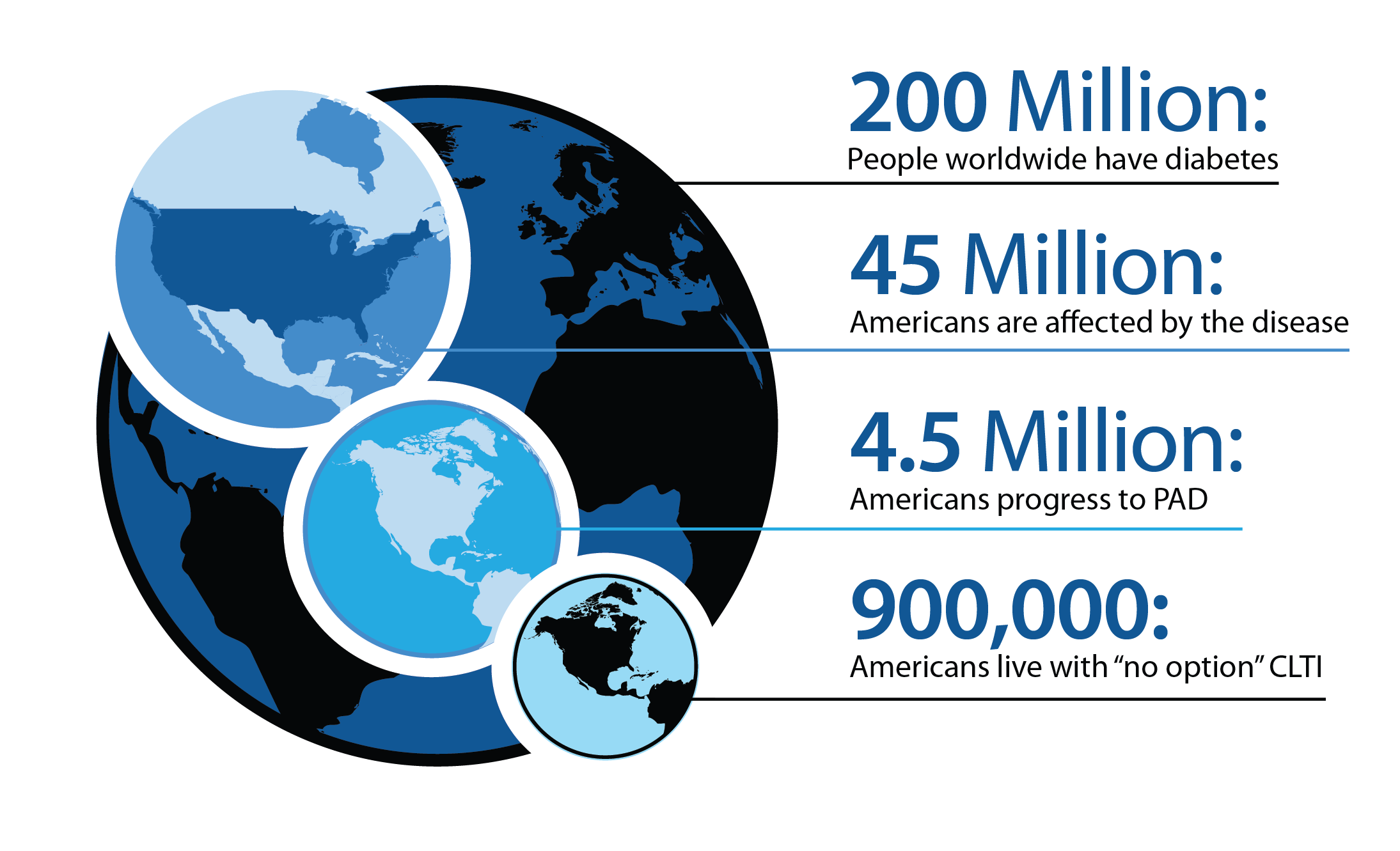
Mortality. Pain. Amputation. Impaired Quality of Life...
These are the symptoms patients with CLTI must contend with, while also being at continuous risk of CV events and sudden death.1
of CLTI patients1
Are diagnosed with diabetes, which is associated with:
- Lower revascularization success rate
- Decreased wound healing
- Higher amputation rates
- Higher mortality rates
Among patients with PAD:2
Develop CLTI
25% of these patients will require amputation to within 1 year to resolve limb pain, nonhealing wounds, and life-threatening infections.
amputations yearly2
Classified as nontraumatic, occurring mostly in patients with PAD and diabetes.
Perioperative mortality rate1
Up to
Higher Mortality Rate3
Within 3 years following lower limb amputation compared to nonamputated patients.
Prevalence of CLI
and likely to rise in the coming years. Risk factors include age, diabetes, and smoking.4
Annual Cost
Preventing major amputations is key to
Reducing Mortality
Yet patients are often undertreated, which contributes to increased amputation rates and adverse outcomes:5
- Less than one-third of patients with CLI are prescribed optimal medical therapy
Limb amputation is too often the primary treatment for CLI, a “concerning disservice” to patients5
"One of the reasons that we see such an epidemic of amputations is because limb salvage can sometimes be extremely challenging, and [it] requires the coordinated efforts of multiple specialties, including podiatry, wound care, and nursing."6
Golzar JA, MD, FACC, FSCAI
Preventing major amputations is key to Reducing Mortality
Yet patients are often undertreated, which contributes to increased amputation rates and adverse outcomes:
• To reduce mortality, treatment should be treated within 2 weeks of diagnosis
• All average-risk CLTI patients are candidates for revascularization
Revacsularization is associated with lower amputation rates and improved mortality (~40% survival vs 22% for amputated patients)
"One of the reasons that we see such an epidemic of amputations is because limb salvage can sometimes be extremely challenging, and [it] requires the coordinated efforts of multiple specialties, including podiatry, wound care, and nursing."
Golzar JA, MD, FACC, FSCAI
A
multidisciplinary team
With the development of new technologies, limiting amputations in patients with no option CLTI is a distinct possibility
A multidisciplinary team is essential for successful treatment, and should include a vascular surgeon, an imaging specialist/radiologist, a wound specialist, an orthopedic surgeon, a podiatric surgeon, a diabetic and wound nurse, a physical therapist, a diabetes educator and a nutritionist
CLTI Multidisciplinary Team
Key members
No Data Found
No Data Found
References
- Ventoruzzo G, Mazzitelli G, Ruzzi U, Liistro F, Scatena A, Martelli E. Limb Salvage and Survival in Chronic Limb-Threatening Ischemia: The Need for a Fast-Track Team-Based Approach. J Clin Med. 2023 Sep 20;12(18):6081. doi: 10.3390/jcm12186081. PMID: 37763021; PMCID: PMC10531516.
- Creager MA, Matsushita K, Arya S, Beckman JA, Duval S, Goodney PP, Gutierrez JAT, Kaufman JA, Joynt Maddox KE, Pollak AW, Pradhan AD, Whitsel LP. Reducing Nontraumatic Lower-Extremity Amputations by 20% by 2030: Time to Get to Our Feet: A Policy Statement From the American Heart Association. Circulation. 2021 Apr 27;143(17):e875-e891. doi: 10.1161/CIR.0000000000000967. Epub 2021 Mar 25. PMID: 33761757.
- Stern JR, Wong CK, Yerovinkina M, Spindler SJ, See AS, Panjaki S, Loven SL, D’Andrea RF Jr, Nowygrod R. A Meta-analysis of Long-term Mortality and Associated Risk Factors following Lower Extremity Amputation. Ann Vasc Surg. 2017 Jul;42:322-327. doi: 10.1016/j.avsg.2016.12.015. Epub 2017 Apr 5. PMID: 28389295.
- Duff S, Mafilios MS, Bhounsule P, Hasegawa JT. The burden of critical limb ischemia: a review of recent literature. Vasc Health Risk Manag. 2019 Jul 1;15:187-208. doi: 10.2147/VHRM.S209241. PMID: 31308682; PMCID: PMC6617560.
- Mustapha JA, Katzen BT, Neville RF, et al. Critical limb ischemia: a threat to life and limb. Endovasc Today. 2019;18(5):80-82.
Integrated Multidisciplinary Limb Salvage Programs: Reducing Amputations Among Patients With Peripheral Artery Disease. Janssen Pharmaceuticals, Inc. 2023 06/23. Available at: https://www.savelegschangelives.com/docs/cp-383321_Limb_Salvage_Profile_in_Care.pdf